Chore chart printable: free charts for ages 3–12, with rewards
A chore chart works when the chores fit the kid, the points make sense, and the reward is more exciting than another sticker nobody asked for. Below you'll find five free chore chart printables: picture charts for little kids, a points chart for bigger kids, a weekly family chart, a sticker reward chart, and reward jar tickets. Then comes the useful bit — chores by age, sensible point values, and rewards that cost nothing.
Free printable templates
 Letter
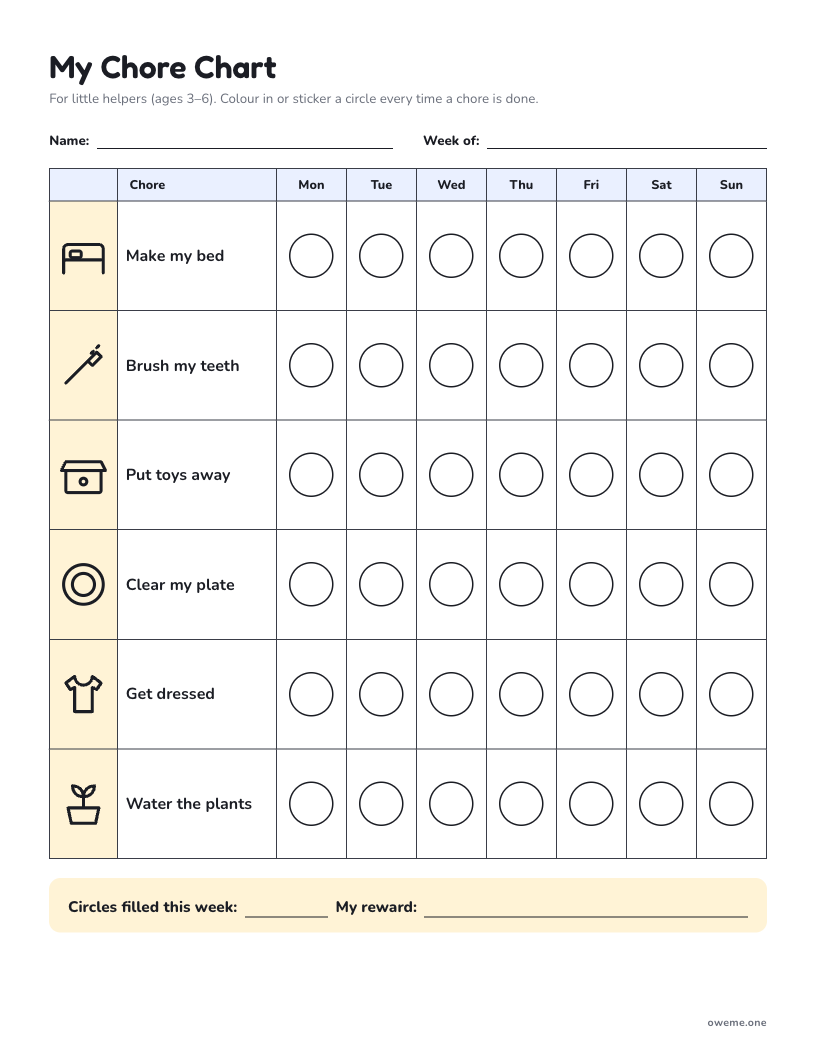
Chore chart for ages 3 to 6 — Six picture-style chores across Monday to Sunday with big circles to check off, made for kids who can't read yet.
 Letter
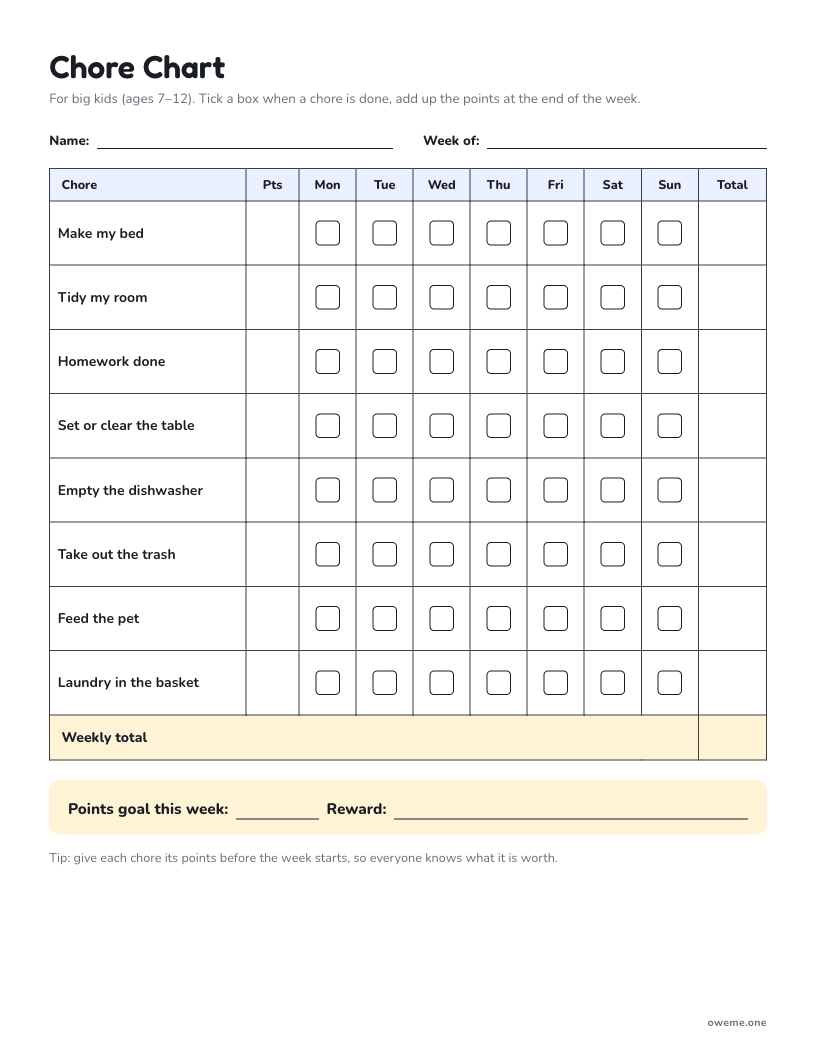
Chore chart for ages 7 to 12 — Eight chores across the week with a points column and a weekly total, for kids who are ready to earn toward something.
 Letter
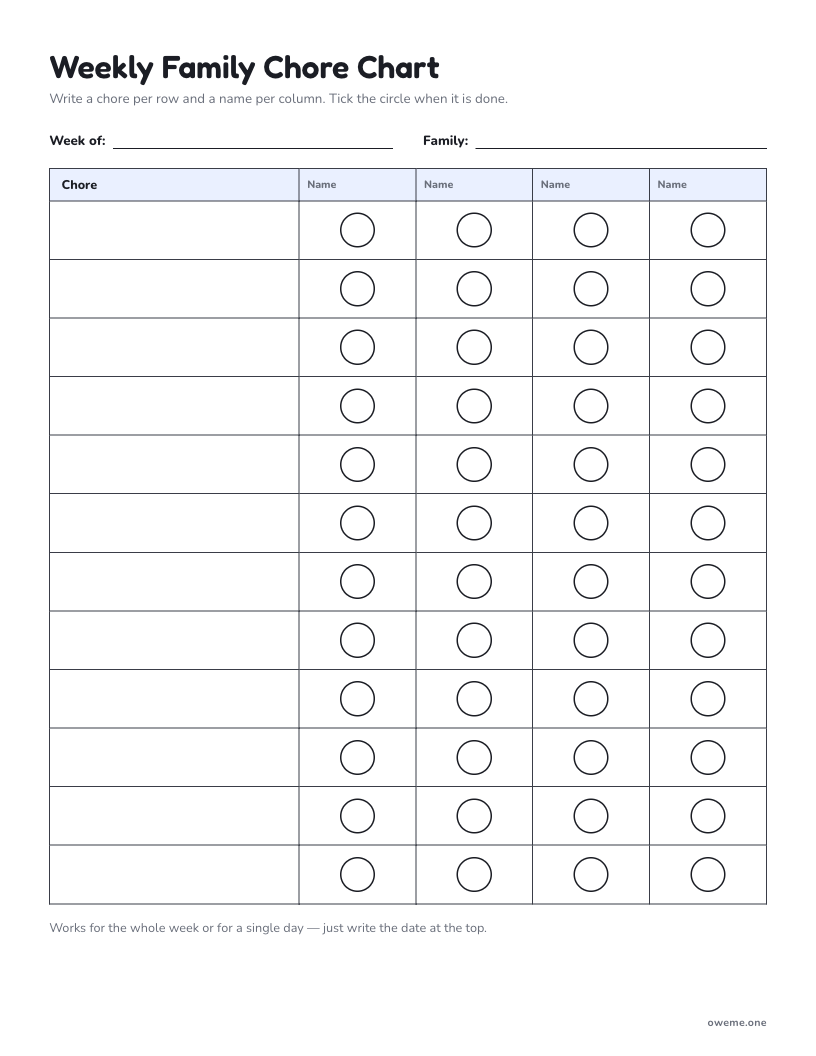
Weekly family chore chart — Blank chore rows and a column per family member, so everyone in the house can see who does what this week.
 Letter
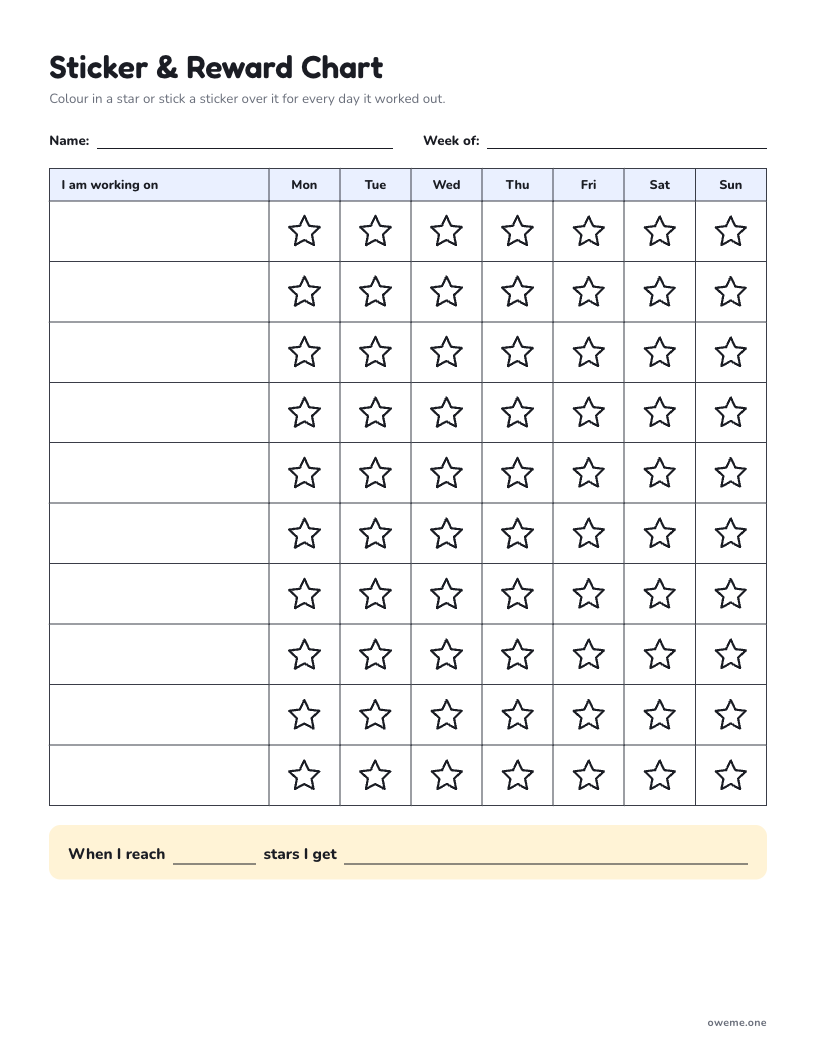
Sticker and reward chart — Ten rows of seven day boxes with stars and a goal line: 'When I reach ___ stars I get ___'. Works with stickers or a marker.
 Letter
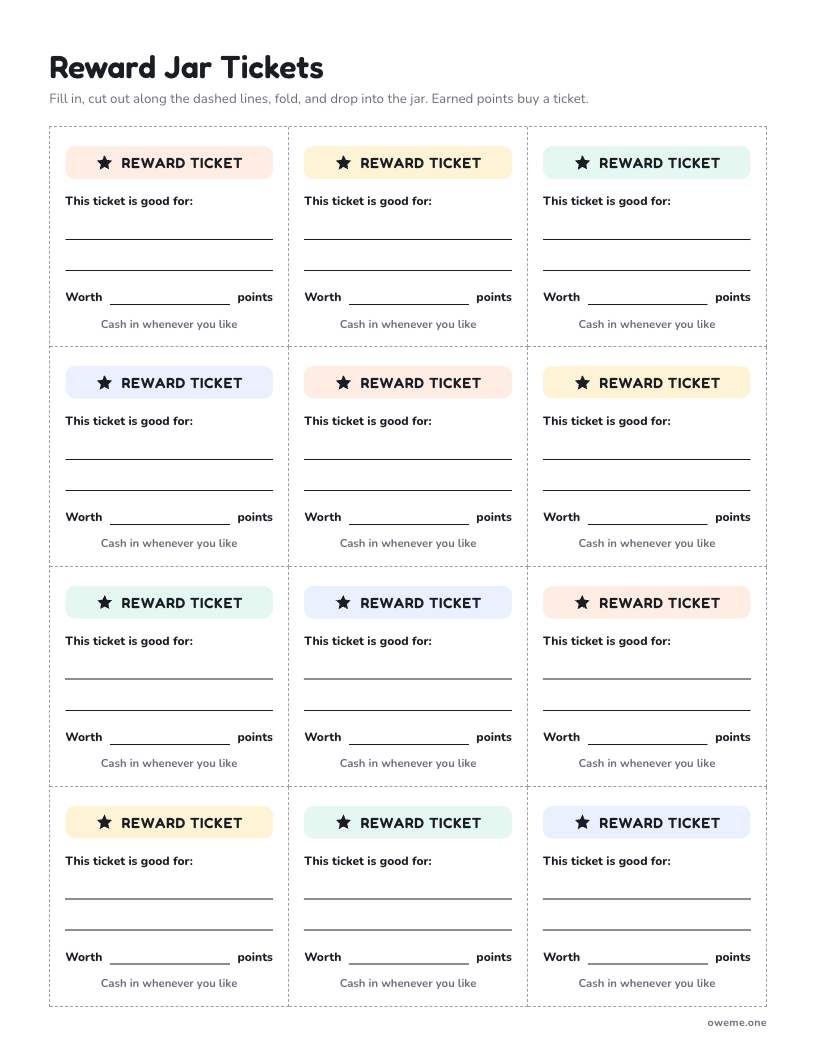
Reward jar tickets — Twelve tear-off tickets that read 'This ticket is good for ____, worth ___ points'. Fill them in, fold them, drop them in a jar.
How to use it
- Pick four to six chores together — Sit down with your kid and choose chores they can finish without help. Four for a preschooler, six for a ten-year-old. Let them pick at least one; they'll defend a chore they chose.
- Agree the point value of each chore — Say the number out loud and write it down before anyone starts. If making the bed is worth 1 point on Monday and suddenly 3 on Thursday, you are no longer teaching responsibility; you are hosting salary negotiations.
- Post the chart where it gets seen — Fridge door, bathroom mirror, or the wall by the shoes. Keep a marker or the sticker sheet tied to it with string so there's never a reason not to tick a box.
- Do a five-minute check-in every week — Same day, same time. Count the week's points together, praise the streaks, and decide if any chore needs swapping. Don't relitigate individual days.
- Hand over the reward — When the goal is reached, the reward happens that week, not 'when things calm down'. A reward that arrives late stops working the second time.
Which chore chart printable fits your kid?
- Ages 3 to 6: the picture chart. Six chores, big circles, no reading needed. Pair it with the sticker and reward chart if your kid loves stickers more than checkmarks.
- Ages 7 to 12: the chart with a points column. They add up their own weekly total, which is half the lesson.
- Several kids or the whole household: the weekly family chart. One column per person; parents get a column too.
- Any age, when you need a goal: the sticker and reward chart plus the reward jar tickets. The chart tracks progress, the jar decides what the progress is for.
Sharing a flat instead of a family home? The chore list for roommates comes with its own rotation chart.
How to choose point values
- Small daily chores, 1 point: make the bed, put dirty clothes in the hamper, clear your plate, feed the pet, hang up your coat.
- Bigger daily chores, 2 points: empty the dishwasher, set the table for everyone, take out the recycling, tidy the living room before dinner.
- Weekly chores, 3 to 5 points: vacuum a room, clean the bathroom sink and mirror, change the bed sheets, sort and fold a load of laundry, wash the car.
- Weekly cap: decide the maximum a kid can earn in a week, usually 15 to 25 points, and make the first reward reachable in one good week. A goal that takes a month is a goal that gets forgotten.
Allowance chart or reward jar? An allowance chart converts points into money at a fixed rate, say 10 points for a dollar. A reward jar trades them for things money cannot quite capture: choosing Friday dinner, an extra story, control of the car playlist. Allowance can teach saving; the jar keeps every clean plate from turning into an invoice. Plenty of families mix both.
Age-appropriate chores
Ages 3 to 6
- Put toys back in the basket
- Carry your plate and cup to the counter
- Put dirty clothes in the hamper
- Feed the pet (with the portion measured out for them)
- Wipe the table with a damp cloth
- Match socks from the clean laundry
- Water a plant with a small cup
- Hang your coat and line up your shoes
Ages 7 to 12
- Make your bed every morning
- Empty the dishwasher
- Set and clear the table
- Take out the trash and recycling
- Vacuum your room
- Pack your own school bag and lunch box
- Fold and put away your laundry
- Sweep the porch or the kitchen floor
Teens
- Cook one family dinner a week
- Clean the bathroom, including the toilet
- Mow the lawn or shovel the walk
- Do a full load of laundry, start to finish
- Wash the car
- Grocery run with a list
- Babysit a younger sibling for an hour
- Change bed sheets for the whole family
Reward jar ideas
Write these on the tear-off tickets, fold them, and let your kid draw one when they hit their goal. None of them cost money.
- Choose what's for dinner on Friday
- Stay up 30 minutes past bedtime
- An extra bedtime story, or two
- A picnic in the living room
- Pick the movie for family movie night
- Breakfast for dinner
- One hour of one-on-one time with a parent, doing whatever they choose
- Trip to the playground or pool
- A sleepover in a blanket fort
- Skip one chore of their choice next week
- Bake cookies together and decorate them
- Control of the car playlist for a week
- A friend over after school
- Pajama day on the weekend
- Choose the family board game, and you don't have to tidy it up afterwards
- A bike ride with a parent to the ice cream place
- Late-night stargazing with hot chocolate
For rewards between adults, the free love coupon book works the same way.
Frequently asked questions
What age should kids start using a chore chart?
Around three, with a picture chart and two or three chores that take under a minute: put toys in the basket, carry your plate to the counter, feed the cat. The checking-off is the point at that age, not the output. By six or seven most kids can handle a points column and a weekly goal.
Should kids be paid for chores?
Families split on this, and both approaches work if they're consistent. If you go the allowance chart route, keep a few 'family chores' that earn nothing, so helping out isn't always a transaction. If you'd rather not tie chores to money, a reward jar with time-based or privilege-based rewards does the same job without the cash.
How many chores should be on a chore chart?
Four to six. A chart with twelve rows looks impressive on day one and gets ignored by day four. Start small, let your kid fill a full week, then add one chore at a time. It's easier to grow a chart that works than to shrink one that's failed.
What do I do when my kid loses interest after a week?
Check three things. Is the reward still something they want? Is the goal reachable within about a week? Are you doing the check-in? Most charts die because the goal is too far away or nobody counts the points. Shorten the goal, swap in a fresh reward from the jar, and restart the chart on a Monday without comment.
Points given, rewards redeemed, no stickers lost
Owe Me One turns the chart into a tiny family reward shop. You choose the rewards, hand out favor points when a chore is finished, and the kids decide whether to spend now or save for something bigger. No missing sticker sheet, no Sunday-night arithmetic, no debate about whether Tuesday was definitely ticked. Free on iPhone.
- Give points from your phone the moment a chore is done
- Kids see their balance and what they're saving for
- Rewards are redeemed with you, not bought with money
Father of two, writes about family routines, chores and rewards that actually work at home.